8½
Otto e mezzo
1963 · Italy · France · 138 min · 1.85:1 · B&W
Directed by Federico Fellini
Introduction
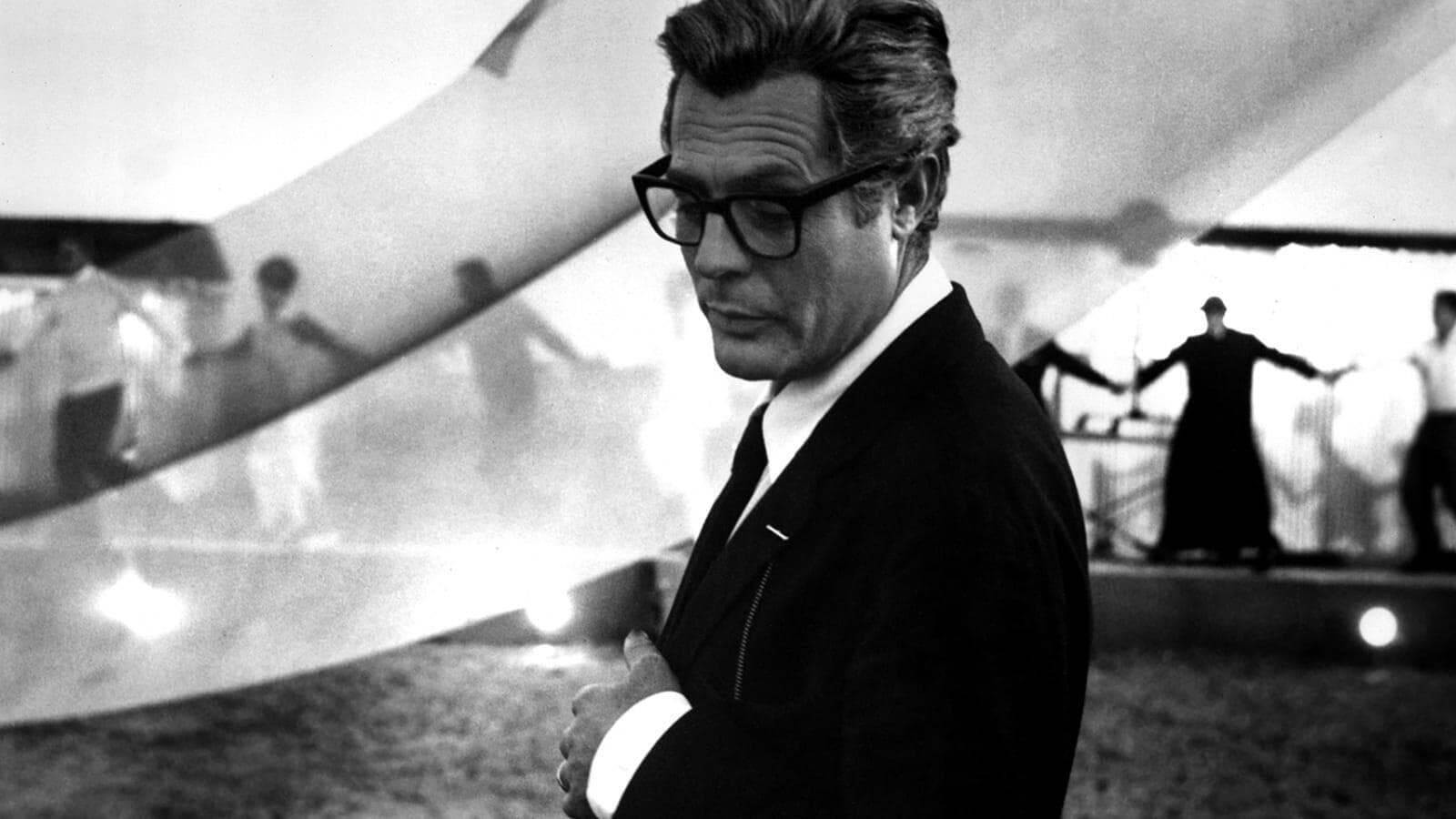
8½ is a 1963 Italian film directed by Federico Fellini, with Marcello Mastroianni as Guido, a film director. Guido has a production scheduled and cannot settle on what to make; the film alternates between his dealings with his producer, his wife and his mistress, his childhood recollections, and sequences that are explicitly dreamed, closing on a dance in a circus ring. Fellini had a start date and a budget in place before he had a subject, and wrote that situation into the screenplay. Dream, memory and present action change places within single shots without transitional cues, a treatment that was uncommon at the time and was widely adopted afterwards. The title comes from Fellini's own count of the films he had directed to that point, in which co-directed work and omnibus episodes are counted as fractions rather than whole films. At the 36th Academy Awards the film received the awards for Best Foreign Language Film and for Best Costume Design in black and white.
Editorial Note
Fellini began with a contract, a start date and no subject, and wrote that condition into the screenplay. Guido is a director with a set already built and a script that never arrives; memory, desire and guilt move into the vacancy. What was new in 1963 and is ordinary now is the cutting: dream, recollection and the present tense change places inside a single shot, with no announcement and no transitional cue. Light does the narrating: Guido's white shirt, the black habits of the nuns, a blown-out patch of steam at the spa all read as emotional states rather than as rendered rooms. Marcello Mastroianni plays the part largely by listening, which is harder than it looks and is what holds the picture together. The circus-ring dance at the end reconciles Guido with his inability to film his life, which is a smaller peace than the one he set out for, though probably the only one available. Plenty of films about blocked artists have come along since. On honesty about the condition I am not sure any of them got much further.
How Crisis Becomes Form
Gianni Di Venanzo photographed the film and Nino Rota wrote the score. The sets were built at Cinecittà in Rome, among them the launch gantry that is never used. During the shoot Fellini kept a note taped to the camera reminding himself that this was a comedy.
It was Italy's submission to the Academy Awards and took the grand prize at the Moscow film festival the same year, a decision that caused some argument at the time. Mastroianni's dark suit, hat and heavy glasses were modelled on Fellini's own.
Titles
- Mainland China
- 八部半
- Hong Kong
- 八部半
- Taiwan
- 八又二分之一
- English
- 8½
- Original
- Otto e mezzo
Cast
- Marcello Mastroiannias Guido
- Claudia Cardinaleas Claudia
- Anouk Aiméeas Luisa
Where to Watch
International
Where-to-watch links are maintained by hand and may lapse as platforms change.